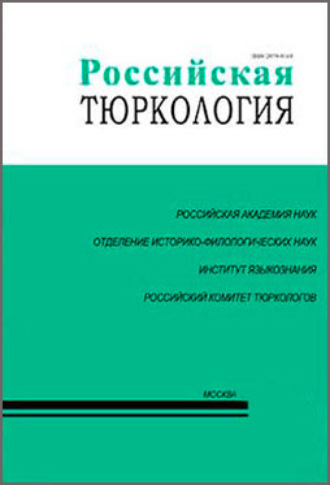
Language in Africa Volume 2, Number 1 (2021)

GRAMMATICAL USES OF THE VERB -GUMA ‘STAY’ IN KIRUNDI (JD62): A LINGUISTICS STUDY BASED ON A CORPUS Abstract: In Bantu languages, verbs that have a general meaning can become grammaticalized. The purpose of this study is to show that in Kirundi (JD62), the variant spoken in Burundi, the stative verb -guma ‘to stay’ can appear in given morphosyntactic structures to contribute to the production of various grammatical semantics. This article examines the different grammatical uses of -guma based on one corpus of Kirundi texts from BantUGent. According to corpus data three grammatical uses of the verb could be identified: continuity, regularity and gradual process. First of all, the verb -guma (used as an auxiliary) marks continuity depending on its conjugation and that of the main verb. Secondly, it marks a regularity of the action described by the main verb. Finally, it is used to mark a gradual process. These grammatical functions as well as the different forms of conjugation of -guma and the main verb do not have the same frequency in the written corpus and in the oral language. The statistical distribution shows that the use of -guma as a continuity marker is more frequent both in the written corpus and in oral language compared to regularity and gradual process. ________________________________________ A SOCIOLINGUISTIC ANALYSIS OF VERBAL GREETINGS, ADDRESS FORMS AND PARALINGUISTIC BEHAVIOURS IN KISUBI Abstract: This paper analyses the greeting system of Kisubi. It specifically seeks: to identify temporal greeting patterns in Kisubi; to determine whether age and gender do dictate the kind of verbal greetings, address forms and paralinguistic behaviours that are used in particular greeting events; to examine different kinship-specific verbal greetings, address forms and paralinguistic behaviours that are used in particular greeting events; and lastly, to assess the role of context in the Kisubi greeting system. Observation and face-to-face interview methods were used to gather data from 36 participants who were obtained using snowball sampling technique, and afterwards they were stratified into different strata depending on age, gender and educational status of a person. This stratification led to the attainment of authentic data. The obtained data were subjected to content analysis from which different themes emerged. It was established that there are four temporal chunks in Kisubi, each of which is associated with its own greeting term. Age, gender, context and kinship relations also determine the type of greeting terms and the honorifics or deferential terms to use. However, the use of honorifics and/or deferential terms is declining gradually. ________________________________________ LINGUISTIC ASPECTS OF THE FORMS OF ADDRESS IN NYAKYUSA Abstract: The main contribution of this article revolves around the choice of address forms as a mechanism to express politeness in an institutionalised setting in African context. To achieve this goal, I worked with spoken texts which enabled to unravel three issues. First, maternal forms of address in Nyakyusa reveal a dichotomy of male-female distinction, which adopts the male-oriented terms when the general population is referred to. Terms of masculine status are preferred in addressing the general public. In this case both male and female members of the community are addressed by male-oriented kin terms. Second, since utility of address forms primarily involves selection of kinship terms, their choice is a strategy employed to express politeness in face-to-face conversations. The extensions and incorporation of kinship terms in the forms of address is a testimony that the Nyakyusa people manoeuvres terms to express politeness. Lastly, Nyakyusa people have adjusted their kin system. This is obvious with such terms as usangasi (< Swahili: shangazi ‘father’s sister’), ugwifi (< Swahili: wifi ‘brother’s wife’) and abalongosi (< Swahili: viongozi ‘leaders’). In this regard, findings show that the lexicon for the traditional leadership is slightly disrupted by the introduction of the modern system of government. HAUSA PHRASEOLOGISMS AS A STRUCTURAL PROPERTY OF LANGUAGE AND CULTURAL VALUE Abstract: The paper discusses phraseological units in Hausa as combinations of lexical units which have grammatical and cultural motivations. Its purpose is to identify language-specific types of structural phraseologisms and their culture-specific meanings. At the structural level, the most productive patterns of verbal phrases and nominal compounds are being presented. Special attention is devoted to various types of verb-based nominal phrases which refer to perceiving the surrounding world through instances of people’s behavior. The structural phraseologisms are also seen as a means of abstract conceptualization and a source of grammaticalization processes. The cultural background of the Hausa phraseologisms is referred to culture key-words and the traces of cultural experience which determine the meaning of the whole phrase. This approach includes a comparative perspective in studies on phrasal expressions in the Hausa language. The examples are taken from lexicographic sources and from descriptive works; they are also extracted from literary texts, the text of Magana Jari Ce [Speech is an Asset] by Abubakar Imam in particular.
- Категория: языкознание
- Правообладатель: Институт языкознания РАН
- Возрастное ограничение: 0+
- Легальная стоимость: 316 руб.
Читать книгу «Language in Africa Volume 2, Number 1 (2021)» онлайн:
Комментарии ():
Вам также может понравиться: