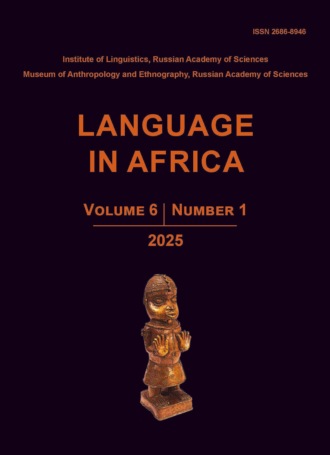
Language in Africa Volume 1, Number 4 (2020)

EMPRUNTS SYNTAXIQUES DU BAMBARA AU FRANÇAIS : UN PREMIER REPÉRAGE Résumé : Contrairement aux emprunts lexicaux, les emprunts syntaxiques du bambara au français n’ont jamais été étudiés. Ce premier repérage, à partir de l’étude de différents textes oraux et écrits, permet de mettre en évidence une dizaine de cas de contamination dont il apparaît que la fréquence est d’autant plus importante qu’il s’agit de traductions du français ou de textes dont le contenu est de type « moderne ». En revanche, dans les textes traditionnels, les emprunts syntaxiques au français sont quasiment absents. ________________________________________ ESSAIS D’ANALYSE SYNTAXIQUE AUTOMATIQUE DANS CORBAMA, LE CORPUS DE RÉFÉRENCE BAMBARA Résumé : En s’appuyant sur une boîte à outil bien conçue qui aide à entrer manuellement les éléments d’analyse syntaxique d’un corpus textuel en bambara, l’auteur a fait une essai de programmation classique à base de règles. Ce n’est pas une approche conforme à l’état de l’art, mais elle s’est avéré faisable et permet d’avancer en attendant, et de faire face à l’énorme quantité de travail requis. ________________________________________ АНТРОПОЛОГИЧЕСКИЙ АНАЛИЗ СКАЗОК БАМАНА Аннотация: Данная статья посвящена анализу двух сказки бамана. Так как основная функция сказки – обучение, в ней всегда сокрыты основные нормы культуры, представлены они могут быть как положительными, так и отрицательными моделями поведения. Две сказки, выбранные нами для анализа, представляют отрицательные модели поведения и рассказывают, в частности, о взаимодействии своего и чужого мира. Таким образом, они рассказывают в основном о нарушениях норм как социальных, так и норм взаимодействия с чужим миром. Именно эти нормы мы и постарались определить. Для анализа были взяты сказки «Гиена съела дочь вождя» и «Сказка про охотника и диких зверей». ________________________________________ SOGOLON Abstract: Sogolon is the name of the mother of Sundiata Keita, the hero of the well-known Mandinka Epic. It is also a surname given by Valentin Vydrin to his daughter Alexandra, co-author of this paper. Finally, it is a word that can be found in a couple of dictionaries of West African languages. Our purpose is to follow some of the tracks that this word opens, which will lead us to unexpected assumptions. ________________________________________ ЗАМЕТКИ О РЕГУЛЯРНОЙ ПОЛИСЕМИИ И ОМОНИМИИ НА ПРИМЕРЕ ЯЗЫКОВ МАНДЕ Аннотация: В статье на примере языков манде рассматриваются возможности использования регулярной полисемии и регулярной омонимии для решения задач компаративистики и семантической типологии. Исследуются три случая. Регулярная полисемия, отмеченная только в языках манде, может быть использована для семантической реконструкции праманде. Регулярная омонимия, отмеченная только в языках манде, позволяет выделить фонетически близкие или омонимичные корни праманде. Регулярная омонимия, отмеченная не только в языках манде, но и в других ветвях нигер-конго, позволяет установить регулярные фонетические соответствия между языками различных ветвей нигер-конго без промежуточных реконструкций. ________________________________________ THE DETRANSITIVIZING SUFFIX -I AND THE RECONSTRUCTION OF PRE-PROTO-MANDE CONSTITUENT ORDER Abstract: The uniformity and total rigidity of the SOVX constituent order across Mande languages constitutes a typological oddity, which led several scholars to discuss the possibility of analyzing it as historically derived from a typologically more common constituent order. In this article, I show that the hypothesis of a historical link between a detransitivizing suffix -i found in some West Mande languages and a reflexive pronoun reconstructable as í has implications for the reconstruction of Pre-Proto-Mande constituent order. ________________________________________ INCORPORATION AND “FORMAL INCORPORATION IN ANALYTIC LANGUAGES: MANDE LANGUAGES AND TYPOLOGY OF INCORPORATION Abstract: Although the Mande languages are usually characterized as analytic, they demonstrate a broader spectrum of typological features. For instance, Gban (South Mande) was analyzed as having evident inflective elements. This paper concerns the phenomenon of incorporation observed in some Mande languages (Mandinka, Tigemaxo, Soninke). It also attempts at attracting attention to the interpretation of some facts which do not suit the definition of incorporation but demonstrate some phenomena, to a certain extent, similar to incorporation (Gban, South Mande). The author (very tentatively) uses the term “formal incorporation for them and offers a new variant of the typology of incorporation, including it into the broader set of different phenomena. It is worth noting that the paper concentrates on the particular sort of incorporation, i.e., object + verb incorporation. ________________________________________ LOROPHORIC STRATEGY IN SAN-MAKA Abstract: The article deals with strategies of coding the participants of communication in reporting discourse in San-Maka (Eastern Mande < Mande < Niger-Congo). San-Maka demonstrates an interesting case wherein 3rd person Sg and Pl pronouns, combined with an emphatic marker sɛ, are used in a logophoric function. However, this construction is not fully grammaticalized. The combination of the pronouns with the emphatic marker acts in a logophoric function in specific reported speech contexts in the presence of the quotative particle mà ~ mə ~ m’ which occupies the leftmost position of the clause. Different possible interpretations of this strategy are shown, followed by a conclusion about the ongoing formation of the logophoric strategy in San-Maka and the grammaticalization of pronouns with the marker sɛ into a specialized logophoric pronoun series. ________________________________________ GOOD NOUNS, NAUGHTY VERBS: HOW FRENCH BORROWINGS RECEIVE GRAMMATICAL TONES IN GUINEAN KPELLE Abstract: The paper discusses how modern French loan nouns and verbs are morphophonologically adapted into Guinean Kpelle (Southwestern Mande), with a special focus on tone. To date, studies of prosodic loanword adaption from stress to tone languages have mainly focused on lexical tone assignment, largely neglecting other phenomena. This study contributes to the discussion by describing primary tone assignment of French loanwords in Guinean Kpelle, and, crucially, by exploring how loan words behave with respect to other complex morphophonological phenomena, mainly, prefixal and replacive grammatical tones, consonant alternations, and surface tone rules. My data suggest that loan nouns perfectly follow native Guinean Kpelle rules, whereas loan verbs have a distinct replacive {HL} morphological marker corresponding to {L} in native verbs. Distinct prosodic marking of loan verbs in Guinean Kpelle broadens our understanding of loanword typology, as well as of grammatical tone. ________________________________________ ANTIPASSIVE CONSTRUCTIONS IN TIGEMAXO (BOZO) Abstract: The present paper investigates the grammar of the 2nd argument, the patient-like object, in Tigemaxo, focusing on first-hand data to describe three different antipassive constructions common in this language. The main questions treated are: What are the ways the 2nd argument is expressed, focusing on the structural possibilities to demote or suppress it? Then, looking at alternative morphosyntactic alternations, what motivates the choice of one of these structures over the other? It will be shown that 2nd argument demotion or suppression is common in Tigemaxo, and that one of the AP constructions is motivated by a stylistic effect. ________________________________________ BRIDGING CAUGHT IN A CROSSFIRE: THE MARKER OF SITUATED DEFINITENESS IN MANO AND LANGUAGE CONTACT Abstract: In this article, I review the basic semantic functions of the determiner à in the South Mande language Mano, which is used to mark situated definiteness: most prominently, bridging and anaphora. The marker derives from the 3sg pronoun. Similar markers are also used in a number of other South Mande languages, including Kla-Dan, Dan-Gweetaa, Guro, Tura and Gban. In Mano, as well as in the former four languages the head noun takes an optional low-tone head marking, which is more frequent in Mano than in other languages. I argue that the increased frequency of use of the marking is influenced by contact with the Southwest Mande language Kpelle, which has a grammaticalized preposed definiteness marker, also deriving from a 3sg prefix, and triggering low tone on the noun it attaches to. ________________________________________ “INFINITIVE CLASS 15 IN DABIDA Abstract: The paper deals with the morphosyntactic properties of infinitives in the Dabida language. As in the majority of Bantu languages, Dabida infinitives are allocated to noun class 15 by virtue of their morphological structure, in particular, the nominal prefix ku-. Nevertheless, from the morphosyntactic point of view infinitives demonstrate a number of nominal and verbal properties that reveal their dual nature. Although these properties are not usually attested in the same ku- form thus contrasting the two uses, there are, however, syntactic positions where both verbal and nominal features are exhibited at once. ________________________________________ THE BEST WAY TO DRINK IN BEJA AND BEYOND: WATER AND MILK Abstract: In the Beja society of the eastern arid zone of Sudan, water and milk are essential beverages for survival, and are also salient elements of the culture as reflected by a rich lexicon. This paper shows how social rules, time intervals, and incompleteness are encoded in monolexemic drinking and milking items, as well as lexical differences based on the animacy hierarchy between humans and animals in the domain of thirst. The structure of the Beja lexicon is compared with that of other African languages, and the Beja social rules related to drinking and milking are illustrated with two anecdotes extracted from oral literature texts. ________________________________________ ВЕРСИЯ ВЕТХОГО ЗАВЕТА НА ЯЗЫКЕ ЗУЛУ В ТИПОЛОГИЧЕСКОЙ ПЕРСПЕКТИВЕ Аннотация: Настоящая статья продолжает типологические исследования стратегий перевода Библии на различные языки. Эти исследования посвящены пассажам и лексемам в каноническом тексте Biblia Hebraica, отражающим древние культурные и религиозные представления, которые не соответствуют более поздним монотеистическим принципам иудаизма и христианства. В каноническом древнееврейском тексте не допускаются никакие изменения. Таким образом, оказываются возможными две стратегии перевода: (1) сохранять эти пассажи в тексте перевода (филологическая стратегия), (2) редактировать эти пассажи в соответствии с монотеистическими принципами (идеологическая стратегия). В центре внимания настоящей работы находится проблема передачи в переводе имени древней семитской богини ’ashera, спутницы верховных богов (’El /’Il/, Ba‘al, YHWH) в некоторых традициях и пантеонах). В различных переводах Библии представлены две традиции передачи имени ’ashera: (1) сохранять имя богини (филологическая стратегия), (2) убирать это имя или заменять его на обозначения ее фетишей и культовых объектов (идеологическая стратегия). В настоящей статье рассматривается передача имени ’ashera в версии Ветхого Завета на языке зулу. ________________________________________ ABSOLUTE-RELATIVE TENSE IN OLD KANEMBU: FOREGROUNDING BY POSTERIOR TAXIS Abstract: Old Kanembu is an extinct Saharan language that survives in annotations to the Qur’anic manuscripts of the 17th to 18th century. The past and future categories of Old Kanembu are absolute-relative tenses with posterior taxis as their orientational mechanism. The posterior location of events in temporal domains is tied up with the communicative goal of guiding the recipient through the complex Qur’anic discourse so that the foreground information and prominent elements are clearly set off against the background events. Similar properties are reported for the past and future tenses in Kanuri and therefore the Old Kanembu data corroborates a previously postulated hypothesis that the past and future in Kanuri are inherently focus categories (Wolff & Löhr 2006). Given that complexity of the Kanuri TAM system – significantly more elaborated than in the other Saharan languages – was triggered by the contact with Chadic languages and that Old Kanembu preserves archaic features going back to the 16th century and beyond, the semantic properties of the Old Kanembu past and future provide additional evidence of early Chadic influence on Kanuri. ________________________________________ ОХОТНИК, КРОКОДИЛ И ЗАЙКА: ПЯТЬ ПОЛЕВЫХ ДНЕЙ АНТОНИНЫ ИВАНОВНЫ КОВАЛЬ В 1993 ГОДУ Аннотация: Статья представляет собой комментированную публикацию нескольких сессий полевой работы с информантами, проведенных ведущим африканистом Антониной Ивановной Коваль в 1993 году. Эта работа была связана с подготовкой сказок-полилингвов на разных диалектах и говорах пулар-фульфульде. В ходе работы А.И. Коваль получила два варианта сказки на говоре Dalaba диалекта фута-джаллон и большое количество сопутствующей лингвистической, социолингвистической и другой информации. Характер этой работы, отраженной в публикуемом документе, представляет большой методологический интерес.
- Категория: языкознание
- Правообладатель: Институт языкознания РАН
- Возрастное ограничение: 0+
- Легальная стоимость: 316 руб.
Читать книгу «Language in Africa Volume 1, Number 4 (2020)» онлайн:
Комментарии ():
Вам также может понравиться: